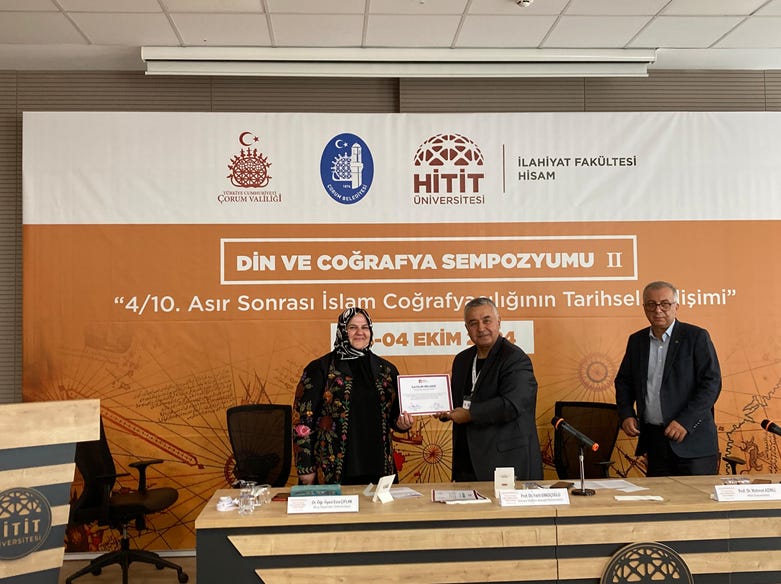
The paper titled “The Geographical Position of Egypt in al-Maqrizi’s al-Hitat” within the Religion and Geography Symposium II was presented by Assoc. Prof. Dr. Esra Çıplak.
The second Religion and Geography Symposium, which was first organized last year with the cooperation of Hitit University Faculty of Theology and Hitit University Islamic Sciences Research and Application Center, was held this year with the theme of “The History of Islamic Geography After the 4th/10th Century” at our faculty Fuat Sezgin Conference Hall on 03-04 October 2024. 37 papers were presented in the opening panel and the following eight sessions by 39 academics from 21 universities in our country. The symposium provided information on methodological discussions, navigation, the use of digital systems in Islamic history, geography and civilization studies, important representatives and works of the Islamic geography tradition, pilgrimage routes, important regions such as Egypt, travelers and Ottoman geography. In this symposium, Assoc. Prof. Dr. Esra ÇIPLAK presented a paper titled The Geographical Position of Egypt in al-Maqrizi’s al-Hitat. In her paper, she provided information about Taqi al-Din Ahmed b. Ali b. Abdulkadir b. Muhammad al-Maqrizi (d. 1442), one of the important scholars of Islamic history, and emphasized that he was the historian with the widest repertoire in 15th century historiography. In particular, his work, al-Mawāʿiẓ wa’l-iʿtibār bi-(fī) ẕikr al-ḫıṭaṭ wa’l-ās̱ār, is a unique achievement that manages to present a general historical discourse through the coherence of history. In al-Khitāt, al-Maqrīzī has analytically addressed the architectural history of the city, which is the basis of the civilization cycle, and the reasons behind the issues. This work, which includes a lot of information such as topography, historical geography, economic and cultural conditions that he embodied on the capital of the Mamluk State, Cairo, must be due to the author’s passion for his own city and country. This work, in which al-Maqrīzī, a historian of the Mamluk period, provides information about the topography and history of Egypt, is the most famous of the book works in the genre of the Hitāt and sets an example for the studies to be done in this field after him. In writing the work, al-Maqrizi, in addition to his own observations and findings, also benefited from two methods of historiography, written and oral. Esra Çıplak stated that she aimed to read the role played by geographical and climatic conditions in the establishment of civilization/umra with climate theory through the pen of the 15th century. She also thanked our Rector Prof. Dr. Mustafa ALICAN for supporting these scientific activities.